Daily Readings | October 24, 2026
Today’s Readings
- Gospel: Luke 7:1–10
- Epistle: St. Paul’s Second Letter to the Corinthians 3:12–18
- Saint of the Day: Holy Great Martyr Arethas and His Companions
Epistle of the Day
Gospel of the Day
Luke 7:1–10
At that time, Jesus entered Capernaum. Now a centurion had a slave who was dear to him, who was sick and at the point of death. When he heard of Jesus, he sent to Him elders of the Jews, asking Him to come and heal his slave. And when they came to Jesus, they besought Him earnestly, saying, “He is worthy to have You do this for him, for he loves our nation, and he built us our synagogue.” And Jesus went with them. When He was not far from the house, the centurion sent friends to Him, saying to Him, “Lord, do not trouble Yourself, for I am not worthy to have You come under my roof; therefore I did not presume to come to You. But say the word, and let my servant be healed. For I am a man set under authority, with soldiers under me: and I say to one, ‘Go, ‘ and he goes; and to another, ‘Come, ‘ and he comes; and to my slave, ‘Do this, ‘ and he does it.” When Jesus heard this He marveled at him, and turned and said to the multitude that followed Him, “I tell you, not even in Israel have I found such faith.” And when those who had been sent returned to the house, they found the slave well.
Gospel Reflection
In this Gospel, a Roman centurion asks Jesus to heal his servant, who is very sick and close to death. Although the centurion is a man of authority, he approaches Jesus with humility, saying that he is not worthy to have Him enter his home. He believes that Jesus does not even need to be physically present to heal his servant. All Jesus has to do is speak, and the servant will be healed.
Jesus is amazed by the centurion’s faith because he trusts completely in Christ’s power, without needing to see a miracle first. The centurion recognizes that Jesus has authority greater than any earthly ruler. His faith is so strong that Jesus praises him before the crowd, and when the messengers return home, they find the servant healed.
The main message is that true faith comes from trusting God wholeheartedly while remaining humble. We do not need to see miracles or have every prayer answered immediately to believe in His power. Like the centurion, we should approach Christ with humility, trust in His will, and remember that nothing is impossible for God.
Saint of the Day
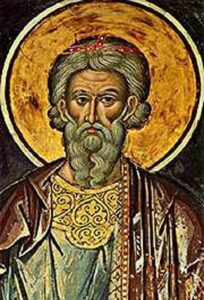
Holy Great Martyr Arethas and His Companions
 During the reign of Emperor Justin, the Christian Kingdom of Ethiopia was ruled by the holy King Elesbaan. Nearby, in the Kingdom of Himyar in Arabia, a cruel ruler named Dhu-Nuwas had converted to Judaism and become a fierce enemy of Christianity. After suffering defeat at the hands of King Elesbaan, Dhu-Nuwas gathered a powerful army and began attacking the Christian cities of his kingdom, determined to destroy those who refused to deny Christ.
One of these cities was Najran, a prosperous Christian city governed by Saint Arethas, a wise and respected man known for his virtue. When Dhu-Nuwas surrounded the city with thousands of soldiers, the Christians courageously defended themselves. Unable to conquer them by force, the ruler resorted to deception. He promised peace and protection if the people opened their gates. Trusting his words, they welcomed him into the city.
But Dhu-Nuwas immediately broke his promise. He ordered the Christians to be arrested and began a terrible persecution. Churches were burned, holy relics were dishonoured, and hundreds of priests, monks, nuns, and faithful Christians were put to death. Among them was a wealthy widow who refused to abandon Christ, even when threatened with torture. Her twelve-year-old daughter also boldly confessed her faith and received the crown of martyrdom.
The following day, Saint Arethas and 340 of his companions were brought before the ruler. Although Arethas was elderly and weakened by suffering, his faith remained unshaken. He encouraged his fellow Christians to remain steadfast, reminding them of the everlasting joy awaiting those who suffered for Christ. Their courage moved the people to tears, and together they declared that nothing, not even death, could separate them from their faith.
Seeing that he could not persuade them to deny Christ, Dhu-Nuwas ordered their execution near the river. After offering their final prayers, the martyrs embraced one another with joy. Saint Arethas was beheaded first, followed by his companions, who willingly gave their lives for the Lord.
A woman named Theroupon, carrying her three-year-old son, came to the place of martyrdom and anointed herself with the blood of the saints. When she too was condemned to death, her young son courageously declared his desire to be with Christ. Seeing his mother thrown into the fire, he ran after her and joined her in martyrdom.
News of the massacre eventually reached Emperor Justin and the Patriarch of Alexandria, who urged King Elesbaan to intervene. With God’s help, Elesbaan defeated Dhu-Nuwas, liberated the Christians, and restored peace to the region. Churches were rebuilt, and a bishop was appointed to care for the faithful.
The Holy Great Martyr Arethas and his companions are remembered for their unwavering faith,