Daily Readings | October 27, 2026
Today’s Readings
- Gospel: Luke 11:1–10
- Epistle: St. Paul’s Letter to the Colossians 2:20–23; 3:1–3
- Saint of the Day: Holy Martyr Nestor, Companion of Saint Demetrius
Epistle of the Day
Gospel of the Day
Luke 11:1–10
At that time, Jesus was praying in a certain place, and when He ceased, one of His disciples said to Him, “Lord, teach us to pray, as John taught his disciples.” And He said to them, “When you pray, say: ‘Our Father which art in heaven, hallowed be Your name. Your kingdom come. Your will be done, as in heaven, so in earth. Give us each day our daily bread; and forgive us our sins, for we ourselves forgive every one who is indebted to us; and lead us not into temptation; but deliver us from evil.'” And He said to them, “Which of you who has a friend will go to him at midnight and say to him, ‘Friend, lend me three loaves; for a friend of mine has arrived on a journey, and I have nothing to set before him’; and he will answer from within, ‘Do not bother me; the door is now shut, and my children are with me in bed; I cannot get up and give you anything’? I tell you, though he will not get up and give him anything because he is his friend, yet because of his importunity he will rise and give him whatever he needs. And I tell you, Ask, and it will be given you; seek, and you will find; knock, and it will be opened to you. For every one who asks receives, and he who seeks finds, and to him who knocks it will be opened.”
Gospel Reflection
In this Gospel, Jesus teaches His disciples how to pray after they ask Him to guide them. He teaches them the Lord’s Prayer, showing that prayer is not just about asking God for things, but also about honouring Him, trusting His will, asking for forgiveness, and forgiving others. Through this prayer, Jesus reminds us that God is our loving Father, who knows what we need and wants us to have a close relationship with Him.
Jesus then tells a story about a man who goes to his friend’s house at midnight asking for bread. Even though his friend is already asleep, the man continues asking until he receives what he needs. Through this example, Jesus teaches us the importance of persistence in prayer. We should not give up praying when our prayers are not answered immediately, but continue turning to God with patience, faith, and trust.
The main message is that prayer requires faith, patience, and trust in God’s goodness. When Jesus tells us to ask, seek, and knock, He encourages us to keep turning to God in every situation. Even when we do not receive exactly what we ask for, we should trust that God hears our prayers and knows what is best for us.
Saint of the Day
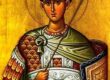
Holy Martyr Nestor, Companion of Saint Demetrius
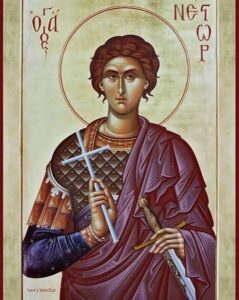 Saint Nestor was a young Christian who lived in Thessalonica during the reign of Emperor Maximian, at a time when Christians were being persecuted for their faith. He was a devoted follower of Christ and greatly admired the Holy Great Martyr Demetrius, who had been imprisoned for openly preaching Christianity.
During this time, Emperor Maximian organized public games and gladiatorial contests to celebrate his military victories. Among the fighters was a powerful gladiator named Lyaios, who was feared for his great strength and skill. He defeated his opponents before large crowds, bringing pride and entertainment to the Emperor.
Seeing this, Saint Nestor decided to challenge Lyaios. Before entering the arena, he went to visit Saint Demetrius in prison and asked for his prayers and blessing. Demetrius made the sign of the Cross on Nestor’s forehead and told him that he would defeat Lyaios but would also suffer martyrdom for Christ.
Strengthened by his faith and the prayers of Saint Demetrius, Nestor entered the arena to face the powerful gladiator. Although he was young and appeared much weaker than his opponent, he placed his trust entirely in God. Before the fight, he cried out, “God of Demetrius, help me!”
With God’s help, Nestor defeated Lyaios, astonishing the Emperor and everyone watching. The crowd was amazed that such a young man had overcome a warrior known for his strength. However, Emperor Maximian was furious at the death of his champion.
When the Emperor learned that Nestor had called upon the God of Demetrius, he ordered the young Christian to be executed outside the city. Saint Nestor courageously accepted his sentence, remaining faithful to Christ until the end. He was beheaded and received the crown of martyrdom.
The victory and martyrdom of Saint Nestor also led to the death of Saint Demetrius, whom the Emperor ordered to be pierced with lances in his prison cell.
Saint Nestor is remembered in the Orthodox Church for his courage, humility, and unwavering faith in God. His life reminds us that true strength does not come from physical power, but from trusting in Christ, even when facing great danger.