Daily Readings | November 16, 2026
Today's Readings
- Epistle: ST. PAUL’S LETTER TO THE ROMANS 10:11–21; 11:1–2
- Gospel: MATTHEW 9:9–13
- Saint of the Day: MATTHEW THE APOSTLE & EVANGELIST
- Fast: ABSTAIN FROM MEAT, DAIRY, EGGS
Epistle of the Day
Brethren, the scripture says, “No one who believes in God will be put to shame.” For there is no distinction between Jew and Greek; the same Lord is Lord of all and bestows his riches upon all who call upon him. For, “every one who calls upon the name of the Lord will be saved.” But how are men to call upon him in whom they have not believed? And how are they to believe in him of whom they have never heard? And how are they to hear without a preacher? And how can men preach unless they are sent? As it is written, “How beautiful are the feet of those who preach good news!” But they have not all obeyed the gospel; for Isaiah says, “Lord, who has believed what he has heard from us?” So faith comes from what is heard, and what is heard comes by the preaching of Christ. But I ask, have they not heard? Indeed they have; for “Their voice has gone out to all the earth, and their words to the ends of the world.” Again I ask, did Israel not understand? First Moses says, “I will make you jealous of those who are not a nation; with a foolish nation I will make you angry.” Then Isaiah is so bold as to say, “I have been found by those who did not seek me; I have shown myself to those who did not ask for me.” But of Israel he says, “All day long I have held out my hands to a disobedient and contrary people.” I ask, then, has God rejected his people? By no means! I myself am an Israelite, a descendant of Abraham, a member of the tribe of Benjamin. God has not rejected his people whom he foreknew.
Gospel of the Day
MATTHEW 9:9–13
At that time, as Jesus passed on, he saw a man called Matthew sitting at the tax office; and he said to him, “Follow me.” And he rose and followed him.
And as he sat at table in the house, behold, many tax collectors and sinners came and sat down with Jesus and his disciples. And when the Pharisees saw this, they said to his disciples, “Why does your teacher eat with tax collectors and sinners?” But when he heard it, he said, “Those who are well have no need of a physician, but those who are sick. Go and learn what this means, ‘I desire mercy, and not sacrifice.’ For I came not to call the righteous, but sinners to repentance.
Gospel Reflection
In this Gospel, Jesus calls Matthew, a tax collector, to leave behind his former life and follow Him. During that time, tax collectors were often disliked and considered sinful because many collected more money than they were owed. Yet Jesus did not judge Matthew by his past, but saw his potential to change and become a faithful disciple. When Christ said, “Follow Me,” Matthew immediately responded, leaving his work behind to begin a new life with the Lord. This reminds us that God’s mercy is greater than our sins and that He calls each of us to repentance and spiritual renewal.
When Jesus shared a meal with Matthew and other tax collectors and sinners, the Pharisees questioned why He would associate with such people. Christ responded by comparing Himself to a physician, explaining that those who are sick need healing. Through this teaching, Jesus reveals that He came to heal those wounded by sin and guide them toward salvation. He also teaches that God desires mercy rather than outward religious practices without sincere love. True faith is not about considering ourselves better than others, but about recognizing our own weaknesses and treating everyone with compassion, humility, and forgiveness.
The main message of this Gospel is that Christ’s love and mercy are offered to everyone, regardless of their past mistakes. Just as Matthew answered Jesus’ call and transformed his life, we are invited to turn away from sin and follow Christ with sincere hearts. We should never lose hope in God’s forgiveness or judge others for their struggles. Instead, we are called to reflect His mercy through kindness, patience, and love, remembering that repentance opens the door to a renewed life in Christ.
Saint of the Day
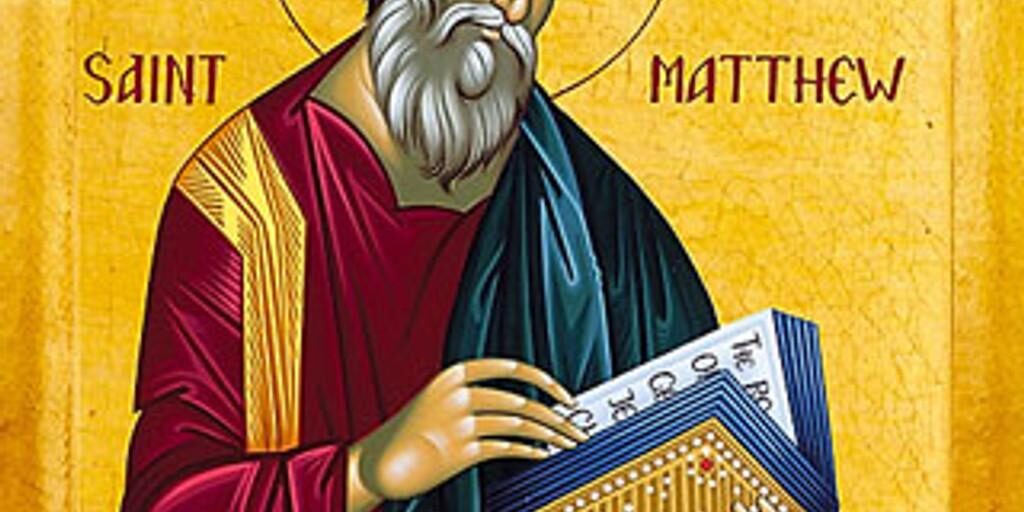
MATTHEW THE APOSTLE & EVANGELIST
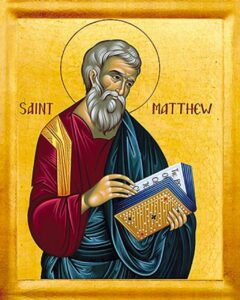 The Holy Apostle and Evangelist Matthew, also known as Levi, was one of the Twelve Apostles of Jesus Christ and the brother of the Apostle James, son of Alphaeus. Before becoming a disciple, he worked as a tax collector in Capernaum, collecting taxes on behalf of the Roman Empire. During this time, tax collectors were often viewed as dishonest and sinful because many took advantage of others for personal gain. However, when Jesus approached Matthew and said, “Follow Me,” he immediately left his former life behind and became a follower of Christ.
After answering the Lord’s call, Saint Matthew welcomed Jesus and His disciples into his home, where they shared a meal with other tax collectors and sinners. This greatly disturbed the Pharisees, who questioned why Jesus would associate with such people. Christ responded that He had come to call sinners to repentance. Deeply moved by the Savior’s mercy, Matthew repented of his sins, made restitution to those he had wronged, and gave his possessions to the poor. From that moment forward, he devoted himself to serving Christ.
As one of the Twelve Apostles, Saint Matthew witnessed the Lord’s teachings, miracles, suffering, death, Resurrection, and glorious Ascension into Heaven. After receiving the Holy Spirit at Pentecost, he began preaching the Gospel in Palestine. At the request of Christian converts in Jerusalem, Saint Matthew wrote the Gospel that bears his name, recording the life and teachings of Jesus Christ. His Gospel emphasizes that Jesus is the promised Messiah foretold by the prophets and teaches about the Kingdom of Heaven, repentance, humility, and the salvation of mankind.
Saint Matthew later traveled to distant lands to spread Christianity, preaching in regions including Syria, Media, Persia, Parthia, and Ethiopia. According to Church tradition, he eventually arrived in Ethiopia, where he converted many people to the Christian faith and established a church in the city of Mirmena. He appointed his companion Platon as bishop and continued teaching the people about Christ. Through his preaching and miracles, many who had previously worshiped idols came to believe in the one true God.
During his missionary work, the Lord appeared to Saint Matthew in the form of a young man and gave him a staff, instructing him to plant it near the church. According to tradition, the staff miraculously grew into a tree that bore fruit, while a stream of water flowed from its roots. Those who ate the fruit and washed in the water experienced a change of heart and became gentle and peaceful. Saint Matthew also healed the wife and son of the local ruler, Fulvian, who were suffering from unclean spirits. These miracles led many people to embrace Christianity, but they angered the ruler, who feared losing his people’s devotion to the pagan gods.
Fulvian accused Saint Matthew of sorcery and ordered his execution. The apostle was placed head downward and surrounded by burning wood, but the flames did not harm him. When more wood was added and pagan idols were placed around the fire, the flames destroyed the idols and threatened the ruler himself. Frightened, Fulvian begged the saint for mercy, and through Matthew’s prayers, the flames were extinguished. Saint Matthew then surrendered his soul to the Lord, receiving the crown of martyrdom for his unwavering faith.
Although Fulvian began to repent, he still struggled with doubt. He ordered Saint Matthew’s body to be placed in an iron coffin and thrown into the sea, declaring that he would believe in Christ if the apostle’s body was miraculously preserved. That night, Saint Matthew appeared to Bishop Platon in a dream and instructed him to go to the seashore. There, the coffin was found and brought back to the church. Witnessing this miracle, Fulvian sincerely repented and was baptized, receiving the Christian name Matthew. He later abandoned his position as ruler, became a priest, and eventually served as bishop, continuing the apostle’s missionary work.
The life of Saint Matthew reminds us that no one is beyond God’s mercy and that true repentance can completely transform a person’s life. From a tax collector who was rejected by society, he became one of Christ’s chosen apostles and a faithful preacher of the Gospel. His example teaches us to answer God’s call with humility, leave behind our sins, and share His love and truth with others.