Daily Readings | November 13, 2026
Today's Readings
- Epistle: ST. PAUL’S LETTER TO THE HEBREWS 7:26–28; 8:1–2
- Gospel: JOHN 10:9–16
- Saint of the Day: JOHN CHRYSOSTOM, ARCHBISHOP OF CONSTANTINOPLE
- Fast: ABSTAIN FROM MEAT, FISH, DAIRY, EGGS
Epistle of the Day
Brethren, it was fitting that we should have such a high priest, holy, blameless, unstained, separated from sinners, exalted above the heavens. He has no need, like those high priests, to offer sacrifices daily, first for his own sins and then for those of the people; he did this once for all when he offered up himself. Indeed, the law appoints men in their weakness as high priests, but the word of the oath, which came later than the law, appoints a Son who has been made perfect for ever. Now the point in what we are saying is this: we have such a high priest, one who is seated at the right hand of the throne of the Majesty in heaven, a minister in the sanctuary and the true tent which is set up not by man but by the Lord.
Gospel of the Day
JOHN 10:9–16
The Lord said, “I am the door; if any one enters by me, he will be saved, and will go in and out and find pasture. The thief comes only to steal and kill and destroy; I came that they may have life, and have it abundantly. I am the good shepherd. The good shepherd lays down his life for the sheep. He who is a hireling and not a shepherd, whose own the sheep are not, sees the wolf coming and leaves the sheep and flees; and the wolf snatches them and scatters them. He flees because he is a hireling and cares nothing for the sheep. I am the good shepherd; I know my own and my own know me, as the Father knows me and I know the Father; and I lay down my life for the sheep. And I have other sheep, that are not of this fold; I must bring them also, and they will heed my voice. So there shall be one flock, one shepherd.
Gospel Reflection
In this Gospel, Jesus describes Himself as the Good Shepherd who loves, protects, and guides His people. Just as a shepherd cares for his sheep and keeps them safe from danger, Christ watches over those who follow Him. He also calls Himself the door, teaching us that salvation and true life are found through Him. Jesus reminds us that He came not only to save us from sin, but to give us a life filled with His love, grace, and presence.
Jesus explains the difference between a good shepherd and someone who only cares for himself. A hired worker may abandon the sheep when danger approaches, but the Good Shepherd is willing to sacrifice His own life for His flock. Through these words, Christ points toward His suffering and death on the Cross, where He willingly gave Himself for our salvation. He also reminds us that He knows each of us personally and desires to bring all people together in faith, forming one flock under one Shepherd.
The main message of this Gospel is that Jesus Christ is our loving Shepherd, who never abandons us and calls us to trust in His guidance. He knows our struggles, weaknesses, and needs, and He invites us to remain close to Him through prayer, faith, and obedience. Just as Christ cares for His flock with patience and selfless love, we are also called to care for others, protect those in need, and help guide one another toward God’s Kingdom.
Saint of the Day
JOHN CHRYSOSTOM, ARCHBISHOP OF CONSTANTINOPLE
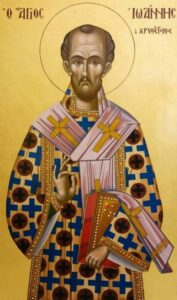 Saint John Chrysostom was born around the year 347 in Antioch into a Christian family. His father, Secundus, died shortly after his birth, leaving his mother, Anthusa, to raise him. Although she was widowed at a young age, she dedicated herself to her son’s education and spiritual upbringing. John received an excellent education in philosophy and public speaking, but his greatest interest became the study of Holy Scripture and the teachings of Christ. Under the guidance of Saint Meletius, Bishop of Antioch, he was baptized in 367 and began his journey of service to the Church.
After his mother’s death, Saint John embraced monastic life, devoting himself to prayer, fasting, silence, and spiritual discipline. He spent several years in the wilderness and lived for two years in a cave, where his strict ascetic practices eventually weakened his health. During this period, he wrote important works about monasticism, the priesthood, and Christian spiritual life. He later returned to Antioch, where he was ordained a deacon in 381 and a priest in 386.
Saint John became widely known for his extraordinary ability to explain the Scriptures and inspire others through his preaching. His powerful and beautiful sermons earned him the name Chrysostom, meaning “Golden-Mouthed.” He preached frequently, teaching Christians how to understand the Word of God and apply it to their daily lives. His writings included explanations of the Gospels, the Epistles of Saint Paul, and many other books of Holy Scripture. Alongside his preaching, he devoted himself to helping the poor, widows, orphans, and those suffering from illness.
In 397, Saint John was chosen to become Archbishop of Constantinople. He continued living a humble and disciplined life, using the resources of the Church to support hospitals, shelters, and those in need rather than spending them on personal comforts. He worked to strengthen the clergy, improve the spiritual life of the faithful, and spread Christianity to surrounding regions. He also contributed greatly to the Church’s worship and liturgical traditions, including the Divine Liturgy that bears his name.
Saint John was known for boldly defending truth and justice, even when doing so placed him in danger. He openly condemned corruption, selfishness, and immoral behavior, including among powerful members of the imperial court. His defense of the poor and his criticism of injustice brought him into conflict with Empress Eudoxia and other influential figures. As a result, he was unjustly accused, removed from his position, and sent into exile. Although he was briefly restored to Constantinople, his enemies continued opposing him, and he was exiled again in 404.
Despite suffering from illness, harsh conditions, and separation from his people, Saint John remained faithful to Christ. During his exile, he wrote numerous letters encouraging Christians, comforting those who suffered, and reminding them to remain strong in their faith. When orders came to transfer him to an even more distant place of exile, his weakened body could no longer endure the difficult journey. Near Comana, he received a vision of Saint Basiliscus, who comforted him and assured him that his suffering was nearing its end.
On September 14, 407, after receiving the Holy Mysteries, Saint John Chrysostom peacefully fell asleep in the Lord. His final words were, “Glory to God for all things!” His holy relics were later transferred to Constantinople in 438. Because September 14 is the Feast of the Elevation of the Holy Cross, his commemoration was also established on November 13.
Saint John Chrysostom’s life reminds us that true faith requires humility, courage, compassion, and perseverance through suffering. Through his teachings, his defense of the poor, and his unwavering devotion to Christ, he continues to inspire Christians to live according to the Gospel and to glorify God in every circumstance.