Daily Readings | November 20, 2026
Today's Readings
- Epistle: ST. PAUL’S SECOND LETTER TO THE THESSALONIANS 3:6–18
- Gospel: LUKE 16:15–18; 17:1–4
- Saint of the Day: Venerable Gregory the Decapolite
- Fast: ABSTAIN FROM MEAT, FISH, DAIRY, EGGS, WINE, OLIVE OIL
Epistle of the Day
Brethren, we command you in the name of our Lord Jesus Christ, that you keep away from any brother who is living in idleness and not in accord with the tradition that you received from us. For you yourselves know how you ought to imitate us; we were not idle when we were with you, we did not eat any one’s bread without paying, but with toil and labor we worked night and day, that we might not burden any of you. It was not because we have not that right, but to give you in our conduct an example to imitate. For even when we were with you, we gave you this command: If any one will not work, let him not eat. For we hear that some of you are living in idleness, mere busybodies, not doing any work. Now such persons we command and exhort in the Lord Jesus Christ to do their work in quietness and to earn their own living. Brethren, do not be weary in well-doing.
If any one refuses to obey what we say in this letter, note that man, and have nothing to do with him, that he may be ashamed. Do not look on him as an enemy, but warn him as a brother.
Now may the Lord of peace himself give you peace at all times in all ways. The Lord be with you all. I, Paul, write this greeting with my own hand. This is the mark in every letter of mine; it is the way I write. The grace of our Lord Jesus Christ be with you all. Amen.
Gospel of the Day
LUKE 16:15–18; 17:1–4
The Lord said to the Jews who came to him, “You are those who justify yourselves before men, but God knows your hearts; for what is exalted among men is an abomination in the sight of God. The law and the prophets were until John; since then the good news of the kingdom of God is preached, and every one enters it violently. But it is easier for heaven and earth to pass away, than for one dot of the law to become void. Every one who divorces his wife and marries another commits adultery, and he who marries a woman divorced from her husband commits adultery.” And he said to his disciples, “Temptations to sin are sure to come; but woe to him by whom they come! It would be better for him if a millstone were hung round his neck and he were cast into the sea, than that he should cause one of these little ones to sin. Take heed to yourselves; if your brother sins, rebuke him, and if he repents, forgive him; and if he sins against you seven times in the day, and turns to you seven times, and says, ‘I repent, ‘ you must forgive him.
Gospel Reflection
This Gospel invites us to a profound interior checkup. It asks us to stop living for the applause of the world, to honor God’s truth in our daily choices, to guard our influence over others so we do not lead them astray, and to choose mercy over holding grudges, no matter how repetitive the offense may be.
Saint of the Day
Venerable Gregory the Decapolite
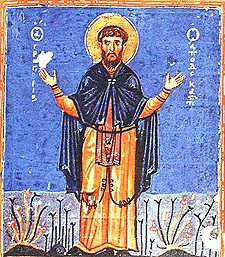
Saint Gregory was born in the Isaurian city of Decapolis (ten cities) in the VIII century. From his childhood he loved the house of God and the Church Services. He read the Holy Scripture constantly and with reverence. In order to avoid the marriage which his parents had intended for him, he left home and spent his entire life wandering. He travelled to Constantinople, Rome, Corinth, and he lived as an ascetic on Olympus for a while. Saint Gregory preached the Word of God everywhere, denouncing the Iconoclast heresy, and strengthening the faith and courage of the Orthodox, who were persecuted, tortured, and imprisoned by the Iconoclasts.
Through his ascetical struggles and prayers, Saint Gregory attained the gifts of prophecy and working miracles. After overcoming the passions and attaining the height of virtue, he was permitted to hear the angelic singing in praise of the Holy Trinity. Saint Gregory left the monastery of Saint Menas near Thessaloniki, where he had labored for a long time, and he went to Constantinople again in order to combat the Iconoclast heresy. At the capital, a grievous illness undermined his strength, and he went to the Lord in the year 816.
Saint Gregory was buried at a monastery in Constantinople, and many miracles took place at his tomb. As a result, the monks recovered Saint Gregory’s holy relics and enshrined them in the church where people could venerate them.
When Constantinople fell to the Turks in 1453, the relics of Saint Gregory were carried to the region of the Danube by a Turkish official. In 1498 Barbu Craiovescu, the Ban of Wallachia heard of the miracles performed by the holy relics and he bought them for a considerable sum of money. Barbu Craiovescu placed the relics in the main church of Bistrița’s Dormition Monastery which he founded at Ramnicu Valcea (Râmnicu Vâlcea),1 where they remain to the present day.
A small booklet describing the miracles and healings performed by Saint Gregory the Decapolite in Romania was written by Igoumeness Olga Gologan, who reposed in 1972.