Daily Readings | November 22, 2026
Today's Readings
- Epistle: ST. PAUL’S LETTER TO THE EPHESIANS 4:1–7
- Gospel: LUKE 12:16–21
- Saint of the Day: Holy Right-Believing Prince Michael of Tver
- Fast: ABSTAIN FROM MEAT, DAIRY, EGGS
Epistle of the Day
Brethren, I, a prisoner for the Lord, beg you to lead a life worthy of the calling to which you have been called, with all lowliness and meekness, with patience, forbearing one another in love, eager to maintain the unity of the Spirit in the bond of peace. There is one body and one Spirit, just as you were called to the one hope that belongs to your call, one Lord, one faith, one baptism, one God and Father of us all, who is above all and through all and in all. But grace was given to each of us according to the measure of Christ’s gift.
Gospel of the Day
LUKE 12:16–21
The Lord said this parable: “The land of a rich man brought forth plentifully; and he thought to himself, ‘What shall I do, for I have nowhere to store my crops?’ And he said, ‘I will do this: I will pull down my barns, and build larger ones; and there I will store all my grain and my goods. And I will say to my soul, ‘Soul, you have ample goods laid up for many years; take your ease, eat, drink, be merry.’ But God said to him, ‘Fool! This night your soul is required of you; and the things you have prepared, whose will they be?’ So is he who lays up treasure for himself, and is not rich toward God.” As he said these things, he cried out: “He who has ears to hear, let him hear.
Gospel Reflection
In this Gospel, Jesus tells the Parable of the Rich Fool to teach us about the dangers of greed and placing our trust in earthly possessions rather than in God. The rich man receives an abundant harvest and decides to build larger barns to store everything for himself. Instead of expressing gratitude to God or considering how he could help others, he focuses entirely on securing his own comfort and wealth. He believes that his possessions will guarantee him many years of happiness, forgetting that his life and everything he owns are ultimately in God’s hands.
God then tells the rich man that his life will end that very night, reminding him that all the wealth he has gathered cannot save him from death. Through this warning, Christ teaches us that material possessions are temporary, while the treasures we build through faith, generosity, and love have eternal value. The man’s mistake was not simply that he was wealthy, but that he allowed his wealth to become the center of his life. He prepared carefully for his earthly future while neglecting the needs of his soul and his relationship with God.
The main message of this Gospel is that true richness is not measured by how much we possess, but by how closely we live with God and how generously we love others. Jesus calls us to use the blessings we receive with gratitude, humility, and compassion rather than becoming attached to worldly comforts. Through prayer, charity, repentance, and acts of kindness, we can build spiritual treasures that will never fade. When we place Christ above material wealth, we learn to live with purpose and prepare our hearts for eternal life in His Heavenly Kingdom.
Saint of the Day
Holy Right-Believing Prince Michael of Tver
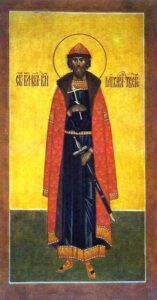 The Holy Right-Believing Prince Michael of Tver was born in 1272, shortly after the death of his father, Great Prince Yaroslav Yaroslavich, the brother of Saint Alexander Nevsky. His father had fallen ill while traveling to the Golden Horde and, before his repose, received monastic tonsure with the name Athanasios. Michael was raised by his mother, Xenia, who instilled in him a deep love for God, the Orthodox faith, and a strong sense of responsibility toward others. He received a careful education under the guidance of an archbishop of Novgorod and eventually became Prince of Tver, succeeding his older brother Svyatoslav.
As a ruler, Saint Michael sought to strengthen both the spiritual and political life of his people. In 1285, he built a stone church dedicated to the Transfiguration of the Savior, replacing an earlier wooden church. Following the death of Great Prince Andrew Alexandrovich in 1305, Michael was recognized as Great Prince according to the established order of succession. However, his position was challenged by Prince Yurii of Moscow, who also desired the title and sought the support of Khan Uzbek of the Golden Horde. Yurii gained the Khan’s favor, married his sister Konchaka, and received the title of Great Prince, leading to conflict between Moscow and Tver.
The struggle eventually developed into open warfare. In December 1317, Saint Michael led the forces of Tver against Prince Yurii and his Tatar allies, defeating them and taking several prisoners. Among those captured were Kavgadi, a commander serving the Khan, and Yurii’s wife Konchaka. Saint Michael showed mercy by releasing Kavgadi, but when Konchaka unexpectedly died while in Tver, Yurii accused Michael of poisoning her. These accusations angered Khan Uzbek, who threatened to destroy Tver unless Michael appeared before him to answer the charges.
Knowing that traveling to the Horde would likely result in his death, Saint Michael chose to surrender himself rather than expose his people to further suffering and bloodshed. Before leaving, he said farewell to his family and the people of Tver and received a blessing from his spiritual father, Igoumen John. He expressed his hope that his own sacrifice might bring peace to his people and asked God to forgive his sins. His decision demonstrated his humility, courage, and willingness to place the welfare of others above his own safety.
Upon arriving at the Horde, Saint Michael was subjected to an unjust trial and condemned for allegedly disobeying the Khan. He was imprisoned in heavy wooden stocks, where he endured humiliation, beatings, and harsh treatment. Despite his suffering, he continued to pray and read the Psalter, placing his trust entirely in God’s will. Because his hands were restrained, a young boy helped him turn the pages of the sacred book. When others suggested that he escape, Michael refused, explaining that he could not abandon his people while they remained in danger. Throughout his imprisonment, Orthodox priests visited him, allowing him to receive Confession and Holy Communion in preparation for his approaching death.
On November 22, 1318, assassins sent at the instigation of Prince Yurii and Kavgadi entered the place where Saint Michael was being held. They brutally attacked him, beating and kicking him before one of them stabbed him and cut out his heart. Saint Michael received the crown of martyrdom, having chosen to sacrifice his life rather than endanger the people entrusted to his care. His body was exposed to dishonor, but according to Church Tradition, a miraculous light appeared over the place where it lay. Witnesses, including both Orthodox Christians and Tatars, saw two radiant clouds shining above his body, and no wild animals approached it.
The holy prince’s body was eventually taken to Moscow and buried in the Monastery of the Savior. When the people of Tver learned of his martyrdom, his wife, Princess Anna, and their children requested permission to bring his remains home. Upon opening his coffin, his body was found to be incorrupt, a sign of God’s grace and the holiness of his life. His relics were solemnly transferred to Tver and placed in the Church of the Transfiguration on September 6, 1320. Princess Anna, his children, the clergy, and countless faithful gathered to receive him with tears and prayers. His veneration began soon afterward, and he was officially glorified throughout the Russian Church in 1549.
Many miracles were later attributed to Saint Michael’s intercessions. During an attack on Tver in 1606, enemy soldiers reportedly saw a mysterious rider on a white horse carrying a sword, who repeatedly drove them away from the city. When they later saw an icon of Saint Michael, they identified him as the rider who had appeared before them. The life of Saint Michael reminds us that true leadership is rooted in humility, self-sacrifice, mercy, and unwavering faith in God. Rather than protecting his own position or seeking revenge, he chose to suffer for the peace and safety of his people, leaving an enduring example of Christian courage and love.