
Daily Readings | November 26, 2026
Today's Readings
- Epistle: ST. PAUL’S FIRST LETTER TO TIMOTHY 3:1–13
- Gospel: LUKE 18:31–34
- Saint of the Day: Venerable Alypius the Stylite of Adrianopolis
- Fast: ABSTAIN FROM MEAT, DAIRY, EGGS
Epistle of the Day
Timothy, my son, the saying is sure: If any one aspires to the office of bishop, he desires a noble task. Now a bishop must be above reproach, the husband of one wife, temperate, sensible, dignified, hospitable, an apt teacher, no drunkard, not violent but gentle, not quarrelsome, and no lover of money. He must manage his own household well, keeping his children submissive and respectful in every way; for if a man does not know how to manage his own household, how can he care for God’s church? He must not be a recent convert, or he may be puffed up with conceit and fall into the condemnation of the devil; moreover he must be well thought of by outsiders, or he may fall into reproach and the snare of the devil. Deacons likewise must be serious, not double-tongued, not addicted to much wine, not greedy for gain; they must hold the mystery of the faith with a clear conscience. And let them also be tested first; then if they prove themselves blameless let them serve as deacons. The women likewise must be serious, not slanderers, but temperate, faithful in all things. Let deacons be the husband of one wife, and let them manage their children and their households well; for those who serve well as deacons gain a good standing for themselves and also great confidence in the faith which is in Christ Jesus.
Gospel of the Day
LUKE 18:31–34
At that time, Jesus, taking his twelve disciples, said to them, “Behold, we are going up to Jerusalem, and everything that is written of the Son of man by the prophets will be accomplished. For he will be delivered to the Gentiles, and will be mocked and shamefully treated and spit upon; they will scourge him and kill him, and on the third day he will rise.” But they understood none of these things; this saying was hid from them, and they did not grasp what was said.
Gospel Reflection
The Courage of Intentional Love
Jesus begins with the words, “Behold, we are going up to Jerusalem.” He is not a victim swept away by tragic circumstances or caught off guard by his enemies. He knows with terrible precision what awaits him: betrayal, mockery, scourging, and death. Yet, he sets his face toward the city anyway. True love is rarely accidental; it is a conscious decision to walk toward the hard things for the sake of others.
The Blindness of Expectations
The most striking part of this reading is the reaction of the Twelve: “They understood none of these things; this saying was hid from them.” Why couldn’t they grasp such plain, explicit language?
The disciples were not unintelligent, but their vision was blocked by their own expectations. They were looking for a conquering king who would overthrow Roman oppression and restore Israel’s political glory. A suffering, humiliated Messiah simply did not fit into their mental framework. When God’s plan contradicts our personal script, we often become deaf to what he is actually saying.
Walking Without Full Understanding
Even though the disciples fail to understand the cross, they do not stop walking with Jesus. They continue up the road to Jerusalem in confusion, trusting the person even when they cannot make sense of the path. Faith does not always mean having all the answers; often, it means staying close to Christ when his words feel hidden or difficult to accept.
Saint of the Day
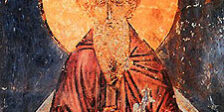
Venerable Alypius the Stylite of Adrianopolis
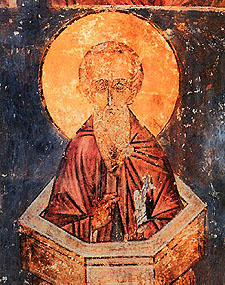
Saint Alypius the Stylite was born in the city of Adrianopolis in Paphlagonia. His mother, a Christian, was widowed early, and she sent her son to be educated by Bishop Theodore. She distributed her substance to the poor, then began to live an ascetic life near the church as a deaconess.
Saint Alypius, from his early years, wanted to devote his life to God and yearned for the solitary life, although Bishop Theodore would not give him permission to do so. Once, when Saint Alypius was accompanying his bishop to Constantinople, the holy Martyr Euphemia (September 16) appeared to him in a vision, summoning Saint Alypius to return to Adrianopolis and found a church in her name.
With contributions offered by believers in Adrianopolis, Saint Alypius did build a church in the name of the holy Martyr Euphemia, on the site of a dilapidated pagan temple infested by legions of devils. Beside the church, under the open sky, the saint erected a pillar over a pagan tomb. For fifty-three years Saint Alypius struggled upon the pillar, praying to God and teaching those who came to him.
The demons which infested the pagan cemetery fell upon the ascetic by night and pelted him with stones. Saint Alypius, wanted nothing to stand in the way of the attacks of the spirits of darkness, then even took down the boards that served him as a roof, protecting him from the rain and wind. In the face of the saint’s conquering steadfastness, the demons forever fled the place, which had been sanctified by his deed of voluntary martyrdom.
Fourteen years before his death, Saint Alypius was no longer able to stand. He was compelled to lie on his side because of the weakness of his legs, and endured grievous sufferings with humble gratitude. Around the saint’s pillar two monasteries sprang up: a men’s monastery on the one side, and a women’s monastery on the other. Saint Alypius introduced strict monastic rules for both monasteries and he directed both monasteries until his death. Saint Alypius reposed in the year 640, at age 118. The body of the venerable stylite was buried in the church he founded in honor of the holy Martyr Euphemia. The relics of the saint of God healed many of those who came in faith.