
Daily Readings | November 27, 2026
Today's Readings
- Epistle: ST. PAUL’S FIRST LETTER TO TIMOTHY 4:4–8, 16
- Gospel: LUKE 19:12–28
- Saint of the Day: Greatmartyr James the Persian
- Fast: ABSTAIN FROM MEAT, FISH, DAIRY, EGGS, WINE, OLIVE OIL
Epistle of the Day
Timothy, my son, everything created by God is good, and nothing is to be rejected if it is received with thanksgiving; for then it is consecrated by the word of God and prayer. If you put these instructions before the brethren, you will be a good minister of Christ Jesus, nourished on the words of the faith and of the good doctrine which you have followed. Have nothing to do with godless and silly myths. Train yourself in godliness; for while bodily training is of some value, godliness is of value in every way, as it holds promise for the present life and also for the life to come. Take heed to yourself and to your teaching; hold to that, for by so doing you will save both yourself and your hearers.
Gospel of the Day
LUKE 19:12–28
The Lord said this parable, “A nobleman went into a far country to receive a kingdom and then return. Calling ten of his servants, he gave them ten pounds, and said to them, ‘Trade with these till I come.’ But his citizens hated him and sent an embassy after him, saying, ‘We do not want this man to reign over us.’ When he returned, having received the kingdom, he commanded these servants, to whom he had given the money, to be called to him, that he might know what they had gained by trading. The first came before him, saying, ‘Lord, your pound has made ten pounds more.’ And he said to him, ‘Well done, good servant! Because you have been faithful in a very little, you shall have authority over ten cities.’ And the second came, saying, ‘Lord, your pound has made five pounds.’ And he said to him, ‘And you are to be over five cities.’ Then another came, saying, ‘Lord, here is your pound, which I kept laid away in a napkin; for I was afraid of you, because you are a severe man; you take up what you did not lay down, and reap what you did not sow.’ He said to him, ‘I will condemn you out of your own mouth, you wicked servant! You knew that I was a severe man, taking up what I did not lay down and reaping what I did not sow? Why then did you not put my money into the bank, and at my coming I should have collected it with interest?’ And he said to those who stood by, ‘Take the pound from him, and give it to him who has the ten pounds.’ (And they said to him, ‘Lord, he has ten pounds!’) ‘I tell you, that to every one who has will more be given; but from him who has not, even what he has will be taken away. But as for these enemies of mine, who did not want me to reign over them, bring them here and slay them before me.'” And when he had said this, he went on ahead, going up to Jerusalem.
Gospel Reflection
In this Gospel, Jesus presents the parable of a nobleman who entrusts his servants with money before departing to receive a kingdom. Upon his return, he rewards those who have faithfully used what they were given, while holding accountable the servant who allowed fear to prevent him from acting. The nobleman represents Christ, and the gifts entrusted to the servants symbolize the blessings, abilities, and opportunities that God has given each of us. We are called to use these gifts responsibly for His glory and the benefit of others.
The servant who hid his money reminds us how fear, spiritual laziness, and a lack of trust can prevent us from growing in our faith. God does not expect everyone to accomplish the same things, but He calls each person to remain faithful with what they have received. Even the smallest acts of kindness, generosity, prayer, and service can bear spiritual fruit when performed with sincere love for God. Our faith should not remain inactive but should be reflected in the way we live and serve others.
The main message of this Gospel is that we are responsible for nurturing the gifts God has entrusted to us and remaining faithful as we await Christ’s return. Rather than allowing fear or complacency to hinder our spiritual growth, we should actively seek opportunities to serve the Lord. Through humility, perseverance, and trust in His grace, we can grow in holiness and prepare ourselves to stand before Him with a faithful heart.
Saint of the Day
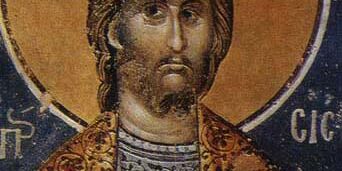
Greatmartyr James the Persian
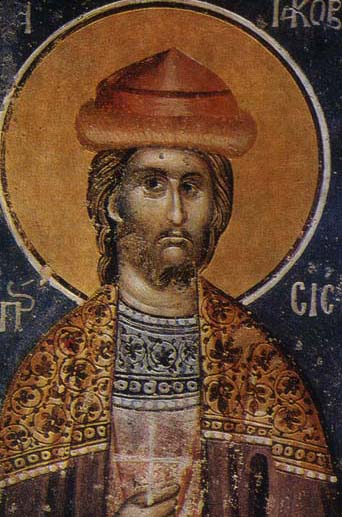
The Holy Great Martyr James the Persian (the Sawn-Asunder) was born in the fourth century into a pious Christian family, both wealthy and illustrious. His wife was also a Christian, and the couple raised their children in piety, inspiring in them a love for prayer and the Holy Scriptures. James occupied a high position at the court of the Persian emperor Izdegerd (399-420) and his successor Barakhranes (420-438). But on one of the military campaigns James, seduced by the emperor’s beneficence, was afraid to acknowledge himself a Christian, and so he offered sacrifice to idols with the emperor.
Learning of this, James’ mother and wife wrote him a letter, in which they rebuked him and urged him to repent. Receiving the letter, James realized the gravity of his sin. Faced with the horror of being cut off not only from his family, but also from God Himself, he began to weep loudly, imploring the Lord for forgiveness.
His fellow-soldiers, hearing him pray to the Lord Jesus Christ, reported this to the emperor. Under interrogation, Saint James bravely confessed his faith in the one True God. No amount of urging by the emperor could make him renounce Christ. The emperor then ordered the saint to be put to death.
They began to cut off his fingers and his toes one by one, then his hands and his feet, and then his arms and legs. During the prolonged torture Saint James offered prayers of thanksgiving to the Lord, Who had granted him the possibility of redemption from his sins by enduring these terrible torments. Finally, the martyr was beheaded. Christians gathered up the pieces of his body and buried them with great reverence.
Commemoration of the Weeping Icon of the Mother of God “of the Sign” at Novgorod
Commemoration of the Weeping Icon of the Mother of God “of the Sign” at Novgorod
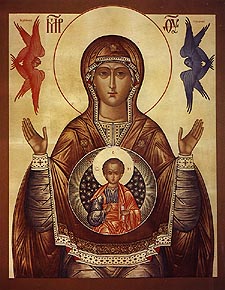
The Icon of the Mother of God “Of the Sign”, depicts the Most Holy Theotokos with prayerfully uplifted hands, and the Divine Infant is at Her bosom in a mandorla (or sphere). This depiction of the Mother of God is regarded as one of the very first of Her iconographic images. In the mausoleum of Saint Agnes at Rome is a depiction of the Mother of God with hands raised in prayer with the Infant Christ sitting upon Her knees. This depiction is ascribed to the fourth century. There is also an ancient Byzantine icon of the Mother of God “Nikopea” from the sixth century, where the Most Holy Theotokos is depicted seated upon a throne and holding in Her hands an oval shield with the image of the Savior Emmanuel.
Icons of the Mother of God, known as “The Sign”, appeared in Russia during the eleventh-twelfth centuries, and were so called because of a miraculous sign from the Novgorod Icon in the year 1170.
In that year the allied forces of Russian appanage princes, headed by a son of Prince Andrew Bogoliubsky of Suzdal, marched to the very walls of Great Novgorod. For the people of Novgorod, their only remaining hope was that God would help them. Day and night they prayed, beseeching the Lord not to forsake them. On the third night Bishop Elias of Novgorod heard a wondrous voice commanding that the icon of the Most Holy Theotokos be taken out of the church of the Savior’s Transfiguration on Ilina street, and carried about on the city walls.
When they carried the icon, the enemy fired a volley of arrows at the procession, and one of them pierced the iconographic face of the Mother of God. Tears trickled from Her eyes, and the icon turned its face towards the city. After this divine Sign an inexpressible terror suddenly fell upon the enemy. They began to strike one another, and taking encouragement from the Lord, the people of Novgorod fearlessly gave battle and won the victory.
In remembrance of the miraculous intercession of the Queen of Heaven, Archbishop Elias established a feastday in honor of the Sign of the Mother of God, which the Russian Church celebrates to the present day. The Athonite hieromonk Pachomius the Logothete, who was present at the festal celebration of the Icon in Russia, composed two Canons for this Feast.
On certain Novgorod Icons of the Sign, the miraculous occurrences of the year 1170 were also depicted. For 186 years afterwards, the wonderworking icon remained in the Savior-Transfiguration church on Ilina street. In 1356 it was transferred to a church built in Novgorod in honor of the Icon of the Most Holy Theotokos “of the Sign,” which became the cathedral church of the monastery of the Sign.
Numerous copies of the Sign Icon are known throughout Russia. Many of them were also glorified by miracles in their local churches, and were then named for the place of the appearance of the miracle. Similar copies of the Sign Icon are the icons of Dionysievo-Glushets, Abalaka (July 20), Kursk, Seraphim-Ponetaev and others.